EN

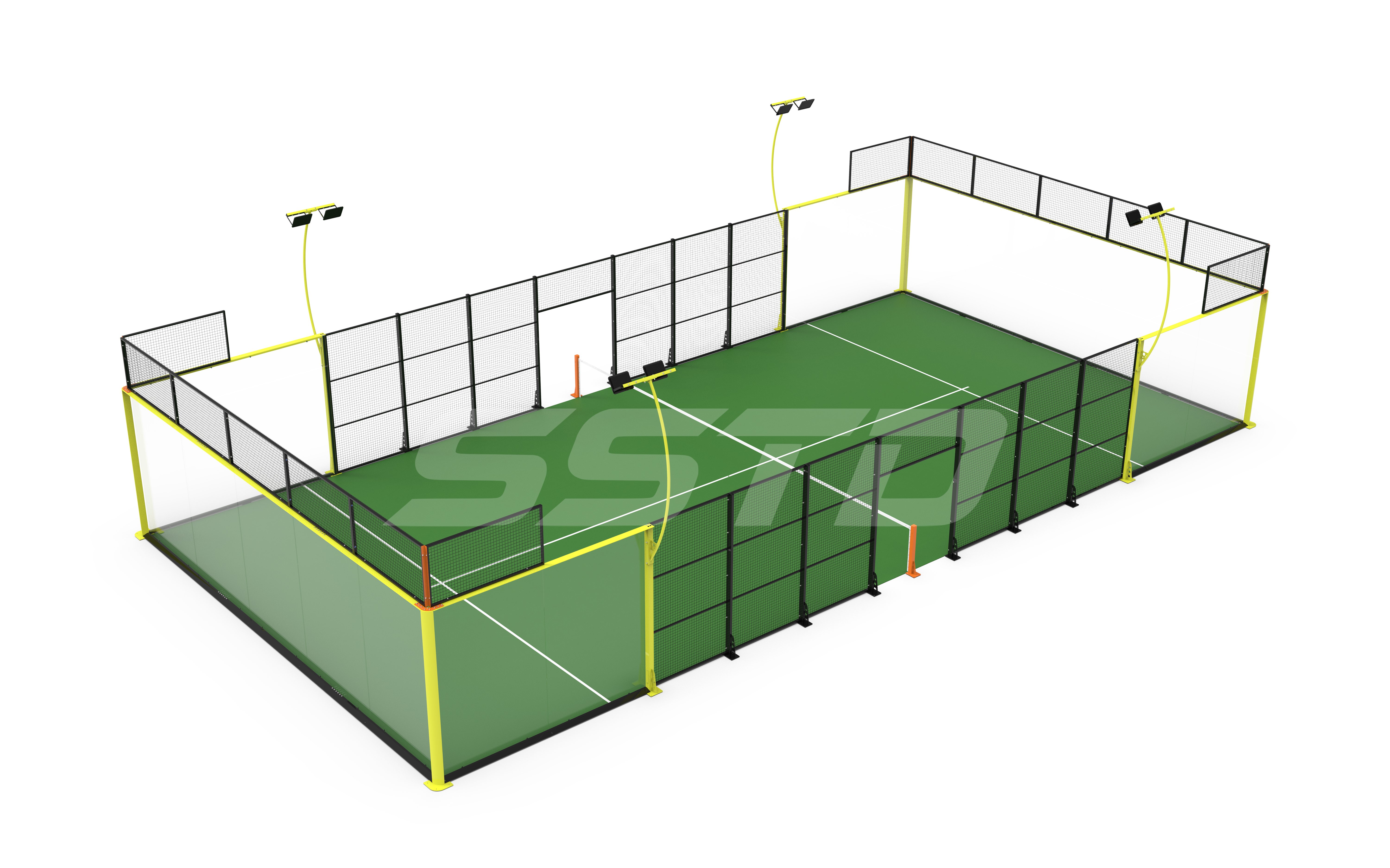
Choosing the right Panoramic Padel Court manufacturer requires more than comparing prices and designs. For sports club owners, distributors, and commercial facility developers, the real challenge is finding a supplier that can deliver reliable playing performance, structural safety, and predictable project costs. A qualified commercial panoramic padel court supplier should provide verified specifications for tempered glass, galvanized steel structures, artificial turf, and lighting systems. Before ordering a custom panoramic padel court, buyers should also check structural load calculations, installation requirements, warranty coverage, and after-sales support. The right manufacturer can help reduce construction risks and build a court that meets the venue's operating needs.
Why Choosing the Right Panoramic Padel Court Manufacturer Matters
A panoramic padel court is an integrated sports structure rather than a simple combination of glass panels, steel posts, and artificial turf. Each component affects the finished court, including ball rebound, player safety, structural stability, and spectator visibility.
Imagine a sports club planning to install four courts in a converted warehouse. The initial quotation looks attractive, but the project becomes more expensive when the proposed court dimensions do not fit the building, the lighting layout needs redesigning, or the foundation requirements were not clearly defined. Later, damaged glass or unavailable replacement components could interrupt bookings after the facility opens.
These problems explain why choosing a manufacturer based only on price can be risky. Buyers need to compare technical specifications, manufacturing experience, installation responsibilities, and long-term maintenance requirements before signing a contract.
A panoramic design is particularly attractive for commercial clubs, premium sports facilities, and venues that want unobstructed views of the playing area. However, appearance should never replace proper engineering, safety documentation, and a suitable installation plan.
What to Prepare Before Choosing a Panoramic Padel Court Supplier
Before requesting quotations, prepare a project brief that explains your site conditions, intended use, technical requirements, and delivery expectations. This helps manufacturers quote against the same requirements and makes supplier comparisons more meaningful.
1. Site Information for Panoramic Padel Court Installation
- Available space: Measure the usable length, width, and height, including access routes and maintenance areas.
- Installation environment: Confirm whether the court will be installed indoors, outdoors, on a rooftop, or inside an existing sports facility.
- Ground conditions: Collect information about the existing concrete slab, soil conditions, foundation capacity, and drainage.
- Climate exposure: Record local wind conditions, rainfall, humidity, temperature variations, and salt exposure where relevant.
- Electrical requirements: Confirm the available power supply and planned lighting configuration.
- Project schedule: Define the target dates for design approval, manufacturing, shipping, installation, and opening.
The International Padel Federation's Rules of Padel specify an internal playing area of 20 m × 10 m. The rules require at least 6 m of unobstructed height above the playing area, while 8 m is recommended for new facilities. These dimensions are a starting point, not the total project footprint. Foundations, circulation space, maintenance access, and any additional competition requirements may increase the space needed.
2. Technical Documents for a Panoramic Padel Court Manufacturer
Prepare a specification sheet covering the main components and services you expect to receive.
- Glass type, thickness, safety documentation, panel dimensions, and fixing method.
- Steel grade, structural profiles, connection details, and corrosion protection.
- Artificial turf construction, pile characteristics, sand infill, and maintenance requirements.
- Lighting output, average illuminance, uniformity, and glare control.
- Foundation interface, anchor bolts, drainage, and structural load calculations.
- Customization options, branding, accessories, and replacement components.
- Manufacturing lead time, shipping arrangements, installation scope, and warranty terms.
Useful purchasing documents include a site plan, preliminary court layout, technical specification sheet, itemized quotation, delivery schedule, and warranty statement. These documents create a consistent basis for evaluating every shortlisted panoramic padel court supplier.
How to Choose the Right Panoramic Padel Court Manufacturer: 8 Steps
Step 1: Verify the Panoramic Padel Court Manufacturer's Experience
Start by checking whether the manufacturer has completed projects similar to yours. Experience with indoor recreational courts does not automatically demonstrate the ability to deliver an exposed outdoor court or a facility designed for competitive events.
Ask for evidence of previous projects, including:
- Completed panoramic and full panoramic padel court installations.
- Project locations, quantities, completion dates, and intended uses.
- Technical specifications for comparable court models.
- References from sports clubs, facility developers, or distributors.
- Details of the manufacturer's role in design, production, and installation.
Where possible, visit an operating court or speak with an existing customer. Ask about installation accuracy, glass replacement, turf maintenance, and how the supplier handles technical problems.
When evaluating Shengshi Sports Tech Tianjin Co., Ltd., apply the same process. Request relevant project records, technical documentation, and a detailed proposal for your intended application. The objective is to establish whether the proposed system matches your requirements rather than relying on general claims about manufacturing experience.
Step 2: Check Panoramic Padel Court Dimensions and Compliance
Correct dimensions are essential for consistent playing conditions and compliance with the requirements of the intended venue. The manufacturer should provide dimensioned drawings rather than asking the buyer to approve a design based only on photographs or a product brochure.
Under the International Padel Federation's Rules of Padel, the standard internal playing area measures 20 m long and 10 m wide. The rules also specify enclosure geometry, net dimensions, and the characteristics of the walls and fencing.
Ask the manufacturer to confirm the following:
- Internal playing dimensions and enclosure heights.
- Glass panel layout and fixing positions.
- Mesh sections and transitions between glass and metal fencing.
- Net position, access openings, and relevant safety clearances.
- Clear height and lighting positions for indoor installations.
Do not assume that a court described as professional-grade automatically meets every competition requirement. Confirm the applicable standards with the relevant sports federation, building authority, and insurance provider. If the venue will host high-level competitions, check whether additional out-of-play areas or other venue-specific provisions are necessary.
Step 3: Evaluate Tempered Glass Quality and Safety
The tempered glass enclosure is one of the most important elements of a panoramic padel court. It affects visibility, ball rebound, structural safety, and the overall appearance of the facility.
Glass thickness is only one part of the specification. Buyers should also evaluate the glass type, tempering process, edge finishing, panel dimensions, fixing system, and relevant safety documentation.
Before approving the proposed glass system, ask the manufacturer to provide:
- Material specifications: Confirm the glass type, nominal thickness, and applicable product standard.
- Safety documentation: Request relevant certificates or test reports for the specified glass.
- Dimensional tolerances: Check panel dimensions, edge quality, and permitted variations.
- Fixing details: Review the connection between the glass, steel frame, and supporting components.
- Replacement arrangements: Confirm whether matching panels can be supplied if glass is damaged during operation.
For example, the Lawn Tennis Association's 2025 padel court construction guidance identifies 10 mm toughened glass for indoor courts and 12 mm for outdoor courts. These are examples from that guidance, not universal requirements for every design or jurisdiction. The final specification should be supported by the applicable standard and an engineering assessment of the proposed court system.
A clear-looking glass panel is not proof of its safety or structural suitability. Reliable documentation and traceability are more useful than appearance alone.
Step 4: Assess the Steel Structure and Corrosion Protection
The steel frame supports the glass, mesh, and other components. Its design must account for the court configuration, anchoring method, environmental exposure, and applicable structural loads.
For outdoor panoramic padel courts, wind-load analysis is particularly important. The enclosure presents a substantial surface to the wind, and the resulting forces must be transferred safely through the frame, anchors, and foundation.
Ask the supplier to specify:
- Steel grade and dimensions of the main structural profiles.
- Whether the structure is hot-dip galvanized, powder-coated, or protected by another defined system.
- Surface preparation and coating specifications.
- Structural calculations for the proposed installation location.
- Base plates, anchor bolts, and foundation connection details.
- Inspection and maintenance procedures for the protective finish.
Hot-dip galvanizing can provide corrosion protection, but actual performance depends on the coating specification, fabrication quality, environment, and maintenance. A powder-coated finish should not be treated as proof of adequate corrosion resistance by itself.
If the court will be installed on a rooftop or in a coastal area, provide the actual site location and exposure conditions before finalizing the design. A standard product drawing may not be sufficient for a site with unusual wind loads or structural constraints.
Step 5: Compare Artificial Turf and Playing Performance
The artificial turf surface affects traction, ball rebound, player movement, and maintenance requirements. For a commercial club, these factors influence the playing experience and the work required to keep the court in good condition.
Ask the panoramic padel court supplier to identify the turf construction, fiber type, pile characteristics, backing, sand infill specification, and recommended maintenance procedures. Request technical data or relevant test results where available.
Compare the following points:
- Ball rebound consistency: The surface should support predictable playing behavior across the court.
- Player movement: The turf should provide suitable traction and support controlled changes of direction.
- Sand infill: Confirm the recommended material, quantity, distribution, and replenishment procedure.
- Drainage: Outdoor courts need an appropriate drainage strategy to prevent standing water.
- Maintenance: Obtain instructions for brushing, cleaning, infill management, and eventual replacement.
Compare equivalent turf specifications across suppliers. Otherwise, a lower quotation may simply reflect a different surface rather than a better price for the same product.
Step 6: Evaluate Panoramic Padel Court Lighting
Lighting requirements depend on whether the facility is intended for recreational play, coaching, regional competition, or higher-level events. A manufacturer's proposed wattage alone does not demonstrate that the court will receive suitable illumination.
The Lawn Tennis Association's 2025 construction guidance provides the following minimum lighting benchmarks for its specified venue categories:
| Venue category | Average illuminance | Uniformity |
|---|---|---|
| Regional competition and recreational use | 300 lux | 0.5 |
| National and international competition | 500 lux | 0.7 |
These figures are guidance-specific benchmarks. Confirm the requirements that apply to your venue and competition category before approving the lighting design.
Request a lighting calculation showing predicted illuminance across the playing area. The proposal should address fixture positions, tilt angles, shadows, glare, electrical requirements, and maintenance access.
For indoor panoramic padel court installation, verify that lighting equipment will not obstruct the required clear playing height. For outdoor facilities, check weather resistance and coordinate the lighting layout with the structural design.
Step 7: Confirm Installation Scope, Warranty, and After-Sales Support
A technically sound court can still become a difficult project if the manufacturer, local contractor, and buyer have different assumptions about who is responsible for the work.
Clarify whether the quotation covers manufacturing only, delivery, installation supervision, complete court assembly, or a wider construction package.
Request a written breakdown of:
- Technical drawings and pre-production coordination.
- Manufacturing milestones and quality inspection.
- Packaging, export documentation, and transportation.
- Foundation preparation, drainage, and electrical infrastructure.
- On-site installation, supervision, and equipment requirements.
- Final inspection, handover documentation, and maintenance training.
- Warranty coverage for glass, steel, turf, lighting, and workmanship.
- Replacement parts, technical support, and defect-handling procedures.
Read the warranty exclusions carefully. Damage caused by foundation movement, incorrect anchoring, or installation outside the manufacturer's instructions may not be covered by a product warranty. The contract should clearly identify the party responsible for each stage.
For buyers considering Shengshi Sports Tech Tianjin Co., Ltd., the evaluation should include the complete delivery scope, installation plan, warranty conditions, and after-sales arrangements alongside the product specifications.
Step 8: Compare the Total Cost of a Panoramic Padel Court Project
The lowest initial quotation is not necessarily the lowest-cost solution. Suppliers may include different components and services in their prices, making a direct comparison misleading.
Use an itemized cost comparison that covers the following categories.
| Cost category | Items to verify |
|---|---|
| Court manufacturing | Glass, steel frame, mesh, turf, net, and included accessories |
| Optional equipment | Lighting, branding, access systems, and additional features |
| Site preparation | Groundworks, foundations, drainage, and electrical infrastructure |
| Logistics | Packaging, freight, insurance, customs duties, and local transport |
| Installation | Labor, supervision, equipment rental, and contractor fees |
| Operating costs | Cleaning, turf maintenance, electricity, inspections, and repairs |
| Long-term support | Replacement glass, spare parts, warranty exclusions, and service charges |
For commercial projects, consider expected booking rates, operating hours, maintenance downtime, and customer demand. A more expensive court may be justified if it delivers a specific operational benefit, but premium appearance alone does not guarantee a stronger financial return.
A Real Panoramic Padel Court Project: Lessons from NorthPoint Padel
A published case study about NorthPoint Padel in Westfield, Indiana, illustrates how site conditions and supplier coordination can influence court selection.
According to a project report published by Padel Alba on Sports Venue Calculator, the club's founders converted an existing warehouse into an indoor padel facility. The building had a ceiling height of 32 feet, approximately 9.75 m. The club selected two full panoramic courts because visibility, glass appearance, and a premium finish were priorities for the venue.
The report states that the manufacturer coordinated with a regional installer, MTJ Sports, and provided technical supervision. Installation was scheduled for eight days but was reportedly completed in 4.5 days. These are reported results from that specific project, not independently established industry averages or a guaranteed installation time for other sites.
The project offers several practical lessons for buyers:
- Check the building before selecting the court: Ceiling height and building suitability can determine whether an indoor project is feasible.
- Choose features according to the venue: The NorthPoint project prioritized unobstructed views and a premium finish because the courts were indoors.
- Coordinate the manufacturer and installer: Technical supervision and clear responsibilities helped the installation team work toward the project schedule.
- Separate installation time from total project time: A short assembly period does not include every stage of site assessment, approvals, foundation work, manufacturing, and shipping.
The same decisions would not necessarily apply to an exposed outdoor facility. Outdoor projects may place greater emphasis on wind-load analysis, corrosion resistance, drainage, and foundation design. The appropriate panoramic padel court system depends on the actual site and intended use.
Common Mistakes When Choosing a Panoramic Padel Court Manufacturer
Mistake 1: Selecting a Supplier Based Only on Price
Problem: A low quotation may exclude installation, lighting, freight, foundation coordination, or essential accessories.
Solution: Request itemized quotations using the same technical specification and delivery scope. Compare the total installed project cost instead of the court package price alone.
Mistake 2: Assuming Every Panoramic Padel Court Has the Same Design
Problem: Court models can differ in visible support structures, glass layout, steel profiles, finishes, and maintenance requirements.
Solution: Request model-specific drawings and a written comparison of standard panoramic and full panoramic designs before choosing a configuration.
Mistake 3: Ignoring Foundation and Drainage Requirements
Problem: An unsuitable base or inadequate drainage can affect court alignment, stability, and playing conditions.
Solution: Have a qualified local engineer assess the site and coordinate foundation design with the manufacturer's drawings before construction begins.
Mistake 4: Accepting Glass Specifications Without Documentation
Problem: Glass thickness alone does not prove that a panel meets the safety and structural requirements of the intended installation.
Solution: Verify the glass specification, relevant test reports, panel tolerances, and fixing details.
Mistake 5: Overlooking Climate and Environmental Conditions
Problem: A court designed without considering wind, humidity, rainfall, or salt exposure may require additional work or maintenance.
Solution: Give the manufacturer the actual installation location and obtain appropriate structural calculations, corrosion protection details, and drainage recommendations.
Mistake 6: Failing to Define Installation Responsibilities
Problem: The manufacturer, buyer, and local contractor may each assume that another party is responsible for foundations, unloading, alignment, or final inspection.
Solution: Establish a written responsibility matrix covering design approval, site preparation, installation, quality control, handover, and warranty obligations.
Panoramic Padel Court Manufacturer Evaluation Checklist
Use the following checklist to compare shortlisted manufacturers before requesting a final quotation.
- Verified experience with comparable panoramic padel court projects.
- Dimensioned drawings and applicable compliance documentation.
- Glass specifications, safety documentation, and traceability.
- Steel structure details and corrosion protection specifications.
- Site-specific structural calculations and foundation coordination.
- Artificial turf specifications and maintenance instructions.
- Lighting calculations appropriate for the intended venue.
- Transparent pricing and a clearly defined supply scope.
- Realistic manufacturing, shipping, and installation schedules.
- Written warranty terms and replacement parts availability.
If several suppliers meet your minimum technical requirements, use a weighted scorecard to make the final decision.
| Evaluation factor | Suggested weighting |
|---|---|
| Technical compliance and safety | 25% |
| Product quality and structural engineering | 20% |
| Relevant project experience | 15% |
| Installation and project coordination | 15% |
| Total project cost | 15% |
| Warranty and after-sales support | 10% |
These weightings are a suggested purchasing framework, not an industry standard. Adjust them to your project. For example, an exposed outdoor facility may place greater emphasis on wind resistance and corrosion protection, while an indoor premium club may prioritize sightlines, lighting, and installation scheduling.
Conclusion: Choose a Panoramic Padel Court Manufacturer for Long-Term Value
The right panoramic padel court manufacturer should demonstrate technical competence, provide verifiable documentation, and deliver a configuration suited to your site and business model. Start with the site assessment, verify the glass and steel specifications, evaluate the turf and lighting, and clarify installation responsibilities before comparing final prices.
For commercial clubs, distributors, and sports facility developers, a structured purchasing process helps reduce hidden costs and avoidable construction problems. When evaluating Shengshi Sports Tech Tianjin Co., Ltd. or another supplier, request relevant project references, a complete technical proposal, an itemized quotation, and clearly defined warranty terms.
Ultimately, a successful full panoramic padel court installation depends on more than appearance. The right tempered glass padel court system, a properly engineered galvanized steel padel court structure, consistent ball rebound, verified structural load calculations, and suitable lighting uniformity all contribute to a safer, more maintainable commercial facility.
Frequently Asked Questions About Panoramic Padel Court Manufacturers
1. What Should I Look for in a Panoramic Padel Court Manufacturer?
Look for relevant project experience, documented technical specifications, appropriate glass safety documentation, structural engineering support, corrosion protection, installation coordination, and clear warranty terms. A reliable manufacturer should explain how its proposed system meets your actual site requirements.
2. What Is the Standard Size of a Panoramic Padel Court?
The standard internal playing area specified by the International Padel Federation is 20 m long and 10 m wide. The total project footprint is larger because foundations, access routes, maintenance space, and any required competition areas must also be considered.
3. What Glass Thickness Is Suitable for a Panoramic Padel Court?
The appropriate thickness depends on the design, installation environment, applicable standards, and engineering requirements. The LTA's 2025 construction guidance identifies 10 mm toughened glass for indoor courts and 12 mm for outdoor courts. Verify the final specification against the relevant local requirements and the manufacturer's technical documents.
4. Is a Full Panoramic Padel Court Better Than a Standard Panoramic Court?
Not necessarily. A full panoramic design generally reduces visible structural interruptions to create more open sightlines. It may suit premium clubs, spectator areas, and high-profile venues. A standard panoramic configuration may offer a better balance of cost, appearance, and operating requirements for other projects. Compare the actual construction details and maintenance implications of both options.
5. How Much Does a Panoramic Padel Court Cost?
The cost depends on the court configuration, glass and steel specifications, turf, lighting, foundations, shipping, installation, and local construction requirements. Request an itemized quotation that separates court manufacturing from site preparation, freight, taxes, electrical work, and installation.
6. How Long Does Panoramic Padel Court Installation Take?
Installation time depends on the court design, number of courts, site readiness, installer experience, weather, and access conditions. One published indoor project involving two full panoramic courts reported an installation time of 4.5 days against an eight-day schedule. This is a project-specific result, not a standard guarantee. Ask for a schedule covering site preparation, manufacturing, shipping, assembly, and final inspection.
7. Can a Panoramic Padel Court Be Installed Outdoors?
Yes, provided the selected system is designed for outdoor use and the site is properly assessed. The design should address wind loads, rainwater drainage, corrosion protection, foundation anchoring, and weather-resistant lighting. The manufacturer and qualified local engineer should confirm suitability for the actual installation location.
8. What Documents Should I Request Before Ordering a Panoramic Padel Court?
Request dimensioned drawings, a bill of materials, glass specifications and relevant certificates, steel structure and coating details, applicable structural calculations, turf documentation, lighting calculations, an itemized quotation, a delivery schedule, and written warranty terms. Confirm the supply scope and site preparation responsibilities before signing the contract.
9. How Can I Verify Whether a Panoramic Padel Court Supplier Is Reliable?
Review completed projects, request customer references, inspect technical documents, and confirm how the supplier handles installation issues and replacement parts. If possible, visit an operating court or speak with an existing customer. Specific evidence is more useful than general claims about quality or experience.
10. Should I Use the Manufacturer's Installation Team or a Local Contractor?
Both options can work. A local contractor may understand regional construction practices, while a manufacturer-appointed team may have more experience with the specific court system. The key factors are installation competence, access to technical drawings, quality control, and clear warranty coverage. If a local contractor performs the installation, establish whether the manufacturer will provide training or on-site technical supervision.
11. How Can I Reduce Panoramic Padel Court Maintenance Costs?
Choose components suited to the local climate, follow the maintenance schedule, brush the turf regularly, maintain the sand infill, and inspect the glass fixings and steel connections. Keep records of inspections and repairs. Obtain written maintenance instructions and confirm the availability of replacement glass, mesh, fasteners, and other essential components before purchasing.
12. What Is the Most Important Factor When Choosing a Panoramic Padel Court Manufacturer?
No single factor guarantees a successful project. The priority is a technically suitable and properly documented court system supported by competent engineering and a clearly defined delivery scope. A manufacturer that provides verifiable specifications, realistic schedules, transparent pricing, and dependable after-sales support is generally a stronger choice than one offering only an attractive design or a low initial quotation.