 EN

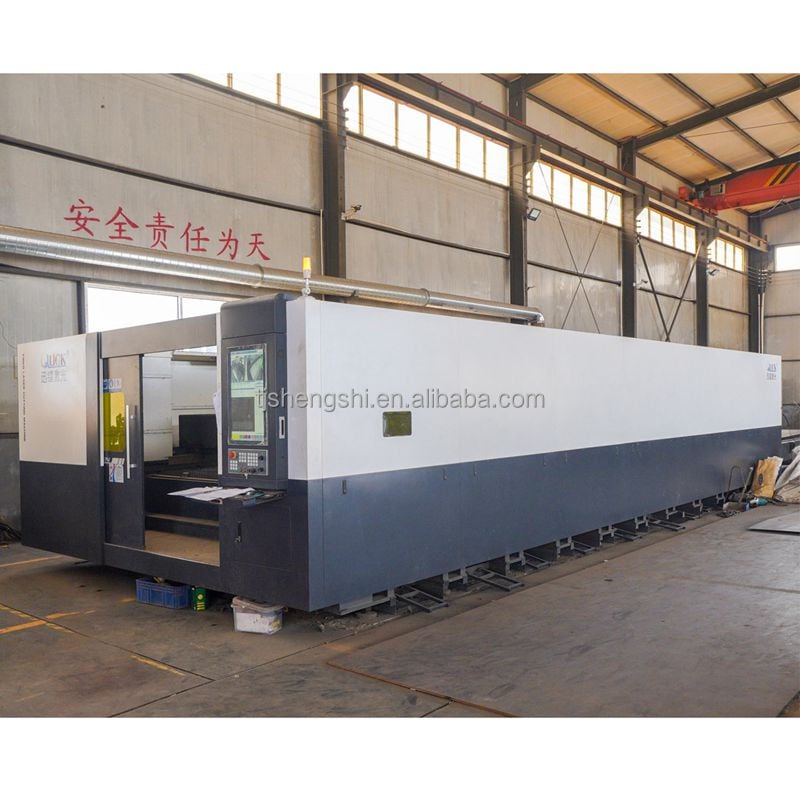
Padel Court manufacturing combines steel-frame fabrication with the preparation of a complete equipment package. At SSTD, our published production information describes laser cutting, CNC processing, robotic welding, shot blasting and protective finishing.[3][4] The finished frame then needs to match the glass, mesh, turf, lighting and accessories specified for the order.[7]
For an importer or club investor, the practical question is how that work becomes a court that can be identified, delivered and assembled at the destination. A cutting machine cannot resolve an unclear order, and a photograph of a finished frame cannot establish that all the required parts are in the shipment.
This guide follows the manufacturing stages described on our product pages and explains the checks buyers should agree for their own orders. Those checks are a purchasing framework, not a promise that every project receives the same tests, inspection report or coating system.

Before manufacturing: approve the court being purchased
Production needs a clear model reference and an agreed configuration. Start with the SSTD Padel Court range, then put the selected model, quantity, colours and included equipment into the quotation and technical documents.
The approval record should identify the enclosure layout, doors, glass arrangement, lighting supports and any branding or roof requirement. A roof should have its own defined structural and supply scope; do not assume it is part of a standard court package.
Use one current set of approved documents. If a customer changes a door position or adds a branded plate, the relevant drawing and component list need review before the affected parts are made. A change accepted only in a message thread can leave the factory, buyer and installer working from different information.
Our guide to importing Padel Courts from China explains why the approved specification, layout, component list and inspection requirements should be settled before production.[7]
The Padel Court manufacturing process
Material preparation and component identification
Our SSTD-003-6 production description includes purchasing steel pipes and checking the material grade on arrival.[4] For a buyer, the useful follow-up is to connect that material information to the frame components in the approved order.
Ask which material records are available for the selected model and whether they identify the relevant components or supply batch. A generic material document is less useful if nobody can explain which part of the shipment it covers.
The frame review should include posts, beams, connection plates, door frames and other steel parts in the supplied configuration. It should also distinguish those fabricated parts from glass, turf, lighting and accessories. Buying a complete court package does not, by itself, establish that every component is manufactured in the same workshop.
Laser cutting and CNC processing
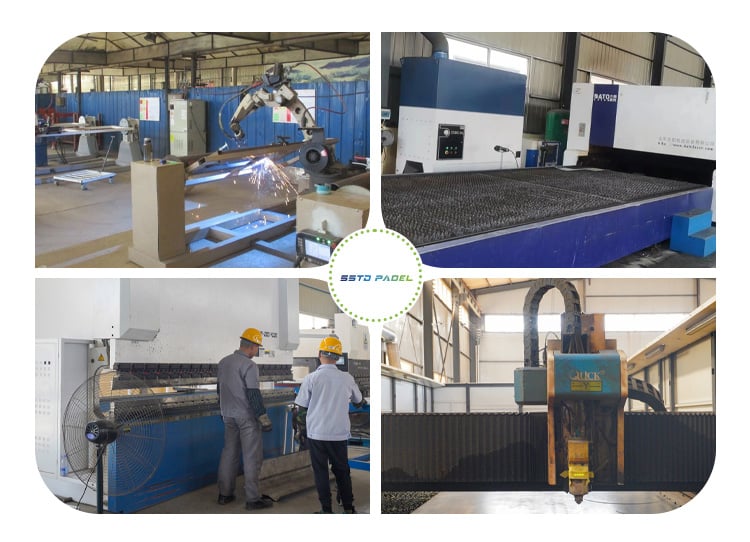
Our published manufacturing information describes automatic laser cutters and CNC band saws for cutting tubes.[3] The SSTD-003-6 page also describes CNC bending equipment for forming frame parts and gusset plates.[4] The applicable operation depends on the component; these are manufacturing capabilities, not a statement that every part passes through every machine.
Cutting and forming give components the geometry needed for later assembly. The buyer's review should focus on the resulting parts: their dimensions, connection positions, edge condition and correspondence with the drawing. Machine names alone do not establish acceptable tolerances.
Custom branding offers a visible example. The SSTD-003-6 custom-logo Padel Court uses laser-cut logos in enlarged gusset plates, and its customization process includes approval of a digital preview before production.[4] Agree the artwork, size and location at that stage rather than asking the installation team to alter a finished structural part on site.
Welding the frame components
Robotic welding is included in our published frame-production description.[3][4] Welding joins the relevant steel parts into fabricated components, while the completed court still depends on the connections and assembly arrangement of the selected model.
A buyer should ask what inspection applies to welded components and which acceptance requirements govern the order. The review can include weld appearance, component alignment and the condition of connection areas, with the required scope agreed in advance. If a project requires specialist weld testing or a particular report, specify it during technical and commercial review rather than assuming it is included.
Do not treat a close-up photograph as proof of weld strength. Photos can help identify a component or show a visible issue, but they cannot replace the measurements, records or testing required by the project.
Surface preparation and protective finishing
Our production information describes shot blasting to remove rust and prepare steel surfaces for coating.[3] Product pages also describe protective treatments including zinc-based coatings, powder coating and, for specified configurations, hot-dip galvanizing.[3][4] The order needs to identify the actual treatment supplied; these terms should not be used as interchangeable descriptions.
Ask for the finish specification by component, including the frame, doors and brackets where applicable. Colour approval is separate from the protective treatment. Matching a colour sample does not establish coating thickness, corrosion performance or suitability for a particular environment.
Tell the sales team if the site is coastal, humid or exposed to demanding weather conditions. The quotation and technical review should address those conditions without relying on a general claim that a finish is suitable everywhere.
Before packing, the agreed inspection should address visible finish damage and any required correction. How repairs are assessed and completed should follow the selected finish system, not an improvised instruction to cover every mark with paint.
Matching the frame to the rest of the court package
A finished steel frame is only one part of the shipment. SSTD's import guide identifies the reference equipment package as including the steel structure, tempered glass, mesh, artificial turf, lighting, net and related accessories, subject to the final quotation.[7]
Check the complete package against the approved component list. Glass-panel quantities and fixing details need to match the enclosure; mesh and doors need to match their openings; lights and brackets need to match the lighting arrangement. Small hardware packages deserve explicit identification because they may be packed separately from the large steel components.
For a multi-court order, agree how shared accessories and model-specific parts will be labelled. If two courts use different configurations, a combined packing list should still make it possible to identify which parts belong to each court.
Not sure which configuration fits your site? Contact SSTD with the location, number of courts and a site photo or reference image. The model and document discussion can start before you have every technical detail ready.
Final quality inspection: agree the scope before production
The SSTD-003-6 product page identifies steel-structure inspection and a pre-shipment quality check.[4] The detailed acceptance criteria, reporting format, inspection access and any independent inspection should be agreed for the individual order.
The following table is a buyer's framework for that agreement. It does not describe a universal SSTD test protocol or set numerical tolerances.
|
Review area |
What the order-specific check should address |
Useful evidence to agree |
|
Model and configuration |
The supplied court matches the approved design, quantity, colours and options. |
Order reference, approved drawing revision and component list |
|
Fabricated steel parts |
Relevant dimensions, connection positions, alignment and visible condition meet the agreed requirements. |
Identified measurement records and component photographs where specified |
|
Welded areas |
The agreed weld inspection has been completed and recorded issues have been resolved. |
Inspection record and any specialist test report required by the contract |
|
Protective finish |
The specified finish and colour apply to the relevant parts; visible damage has been addressed. |
Finish description, agreed inspection results and repair record if applicable |
|
Glass and enclosure |
Panel quantities, identification, visible condition and associated fittings match the order. |
Glass schedule, component check and packaging photographs |
|
Turf, lighting and hardware |
Types, quantities and separately packed accessories match the supplied scope. |
Itemised checklist linked to package numbers |
|
Documents and packing |
The packing list, labels and agreed technical documents refer to the same order. |
Final packing list, package marks and agreed loading records |
Make the acceptance process usable. Decide who reviews the records, who resolves discrepancies and what must be completed before shipment is authorized under the contract. If an independent inspector is involved, agree access and inspection timing before packages are closed.
Factory inspection does not replace destination receiving checks or final site acceptance. SSTD's import guide treats pre-shipment review and arrival inspection as separate steps.[7] Foundation suitability, local assembly, electrical connection and completed-court acceptance still need to be addressed at the project site.
Packing and loading for an identifiable shipment
Our published packing descriptions include plywood cartons for tempered glass, paper boxes for lights and polyethylene foam for frame parts.[3][4] The exact packing arrangement should be stated for the order and transport method rather than assumed from a general product description.
A practical packing list connects each package number to its contents, quantity and relevant handling information. For example, a separately packed hardware carton should be identifiable without opening every package at the destination. Discuss spare components explicitly; a spare-parts allowance is not an automatic inclusion.
Before loading, agree which photographs or records the buyer needs. Package identification, visible protection and loading arrangement are more useful when they can be matched to the packing list. A container photograph alone cannot confirm the quantity or condition of everything inside.
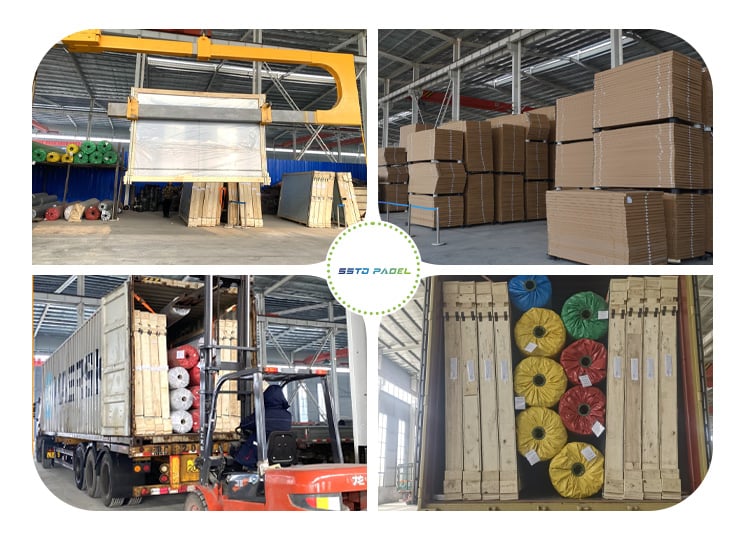
Arrange suitable unloading equipment and a receiving area before the goods arrive. Retain package numbers and record visible damage or shortages before installation, following the agreed notification procedure and relevant transport or insurance terms. Do not assume that every transit issue has the same remedy.
What to ask during a factory review
A useful factory review connects the manufacturing operations to the product you intend to order. General workshop images can introduce the supplier, but order-specific questions provide a better basis for a purchasing decision.
Ask how the approved drawing reaches production, how component changes are controlled and which inspection records can be provided. Where sample parts are available, ask how they relate to the quoted model rather than assuming that any displayed frame represents your configuration.
Also clarify which components are fabricated in-house and which are supplied as part of the complete package. The answer helps define documentation, replacement-part identification and responsibility for compatibility. It should not be inferred from the word "manufacturer."
If you need a live factory review, independent inspection or additional reporting, raise that requirement during quotation. Availability, access, timing and any extra cost should be agreed before production starts.
FAQ
Does laser cutting guarantee the accuracy of the finished Padel Court?
No. Laser cutting is one manufacturing operation. The finished result also depends on the approved design, subsequent fabrication, component checks and correct site assembly. Compare the agreed acceptance requirements and evidence, not just the machine description.
Does SSTD use robotic welding?
Yes. Our published production information describes robotic welding for frame fabrication.[3][4] The welding and inspection requirements applicable to a specific order should be reviewed with the selected model and component drawings.
Are all SSTD Padel Courts supplied with the same surface treatment?
Do not assume that. Product pages describe different protective-treatment terms and model configurations.[3][4] Request the finish specification for the parts in your quotation, particularly for coastal or otherwise demanding sites.
Can our club logo be added during manufacturing?
The SSTD-003-6 model offers laser-cut logos in enlarged gusset plates, with a digital preview for approval before production.[4] Discuss the selected model, artwork and placement with SSTD; custom branding should be incorporated into the approved design.
Is a complete court assembled in the factory before every shipment?
A general manufacturing description does not establish that. If you require a trial fit or complete factory assembly, ask whether it is included for your model and agree its scope, evidence, timing and cost in writing.
Can we request an independent pre-shipment inspection?
Raise the request during quotation so access, scope, timing and responsibilities can be agreed. The inspector should work from the approved order documents and acceptance criteria, rather than a generic checklist unrelated to the supplied model.
Does factory completion mean the court is ready to open?
No. Freight, import procedures, foundation work, unloading, site installation and electrical work are separate parts of the project unless expressly included in the agreed scope.[7] The finished installation needs its own checks before use.
Discuss your Padel Court manufacturing requirements
Send SSTD your country and city, the number of courts, indoor or outdoor location, and any preferred model, colour or branding. Site photos or a reference image are enough to begin the discussion. Mention a roof requirement or any inspection and documentation conditions that could affect the quotation.
We can discuss the selected model and supplied scope, then identify the drawings and commercial details needed for your project. You can browse the Padel Court product range and the SSTD Cases section, or contact SSTD for a project quotation.
Sources
[3] https://www.sstdsports.com/wholesale-panoramic-paddle-court-indoor-padel-tennis-courts-001-3 — SSTD Full View Panoramic Court: production and packing [4] https://www.sstdsports.com/logo-plate-360-panoramic-padel-court — SSTD-003-6: logo customization, manufacturing and quality [7] https://www.sstdsports.com/blog/how-to-import-padel-courts-from-china — How to Import Padel Courts from China: A Step-by-Step Guide
Table of Contents
- Before manufacturing: approve the court being purchased
- The Padel Court manufacturing process
- Final quality inspection: agree the scope before production
- Packing and loading for an identifiable shipment
- What to ask during a factory review
-
FAQ
- Does laser cutting guarantee the accuracy of the finished Padel Court?
- Does SSTD use robotic welding?
- Are all SSTD Padel Courts supplied with the same surface treatment?
- Can our club logo be added during manufacturing?
- Is a complete court assembled in the factory before every shipment?
- Can we request an independent pre-shipment inspection?
- Does factory completion mean the court is ready to open?
- Discuss your Padel Court manufacturing requirements
- Sources