 EN

Introduction: Why Panoramic Padel Court Design Is Gaining Popularity
Sports clubs and facility developers face a growing challenge: how can they build a padel court that attracts players, improves spectator visibility, and creates a recognizable venue identity? A Panoramic Padel Court addresses these needs through wider glass visibility, reduced structural obstructions, and customizable court configurations. According to the International Padel Federation (FIP) 2026 World Padel Report, the sport has exceeded 40 million active players worldwide, while the number of courts is growing by more than 20% annually. As competition between sports facilities increases, 360-degree panoramic padel court design is becoming an important consideration for premium clubs, tournament venues, and commercial sports developments.
What Is a Panoramic Padel Court?
A Panoramic Padel Court is a padel playing facility designed with large transparent glass panels and a structural frame that minimizes visual obstructions. Compared with traditional padel courts, panoramic designs reduce the number of visible vertical support posts, allowing spectators and cameras to view rallies from more angles.
The standard playing area remains 20 meters long and 10 meters wide, following FIP court dimensions. The enclosure combines glass walls and metallic mesh to provide ball rebound and player protection.
Several technical terms are important when evaluating panoramic court designs:
-
Tempered Glass: Heat-treated safety glass designed to provide the strength and safety characteristics required for padel court enclosures.
-
Frameless Glass Structure: A structural arrangement that minimizes visible vertical profiles between glass panels while maintaining secure connections and load transfer.
-
Hot-Dip Galvanized Steel: Steel protected by a zinc coating to improve corrosion resistance, particularly in outdoor environments.
-
Panoramic Support Structure: A specially engineered steel framework that supports glass panels while maintaining open sightlines.
-
Artificial Turf System: A sports surface designed to provide appropriate ball rebound, traction, rotational resistance, and player comfort.
It is important to distinguish between standard panoramic and full panoramic designs. Some panoramic courts retain corner or intermediate support posts, while 360-degree super panoramic models aim to remove these obstructions from the glass walls.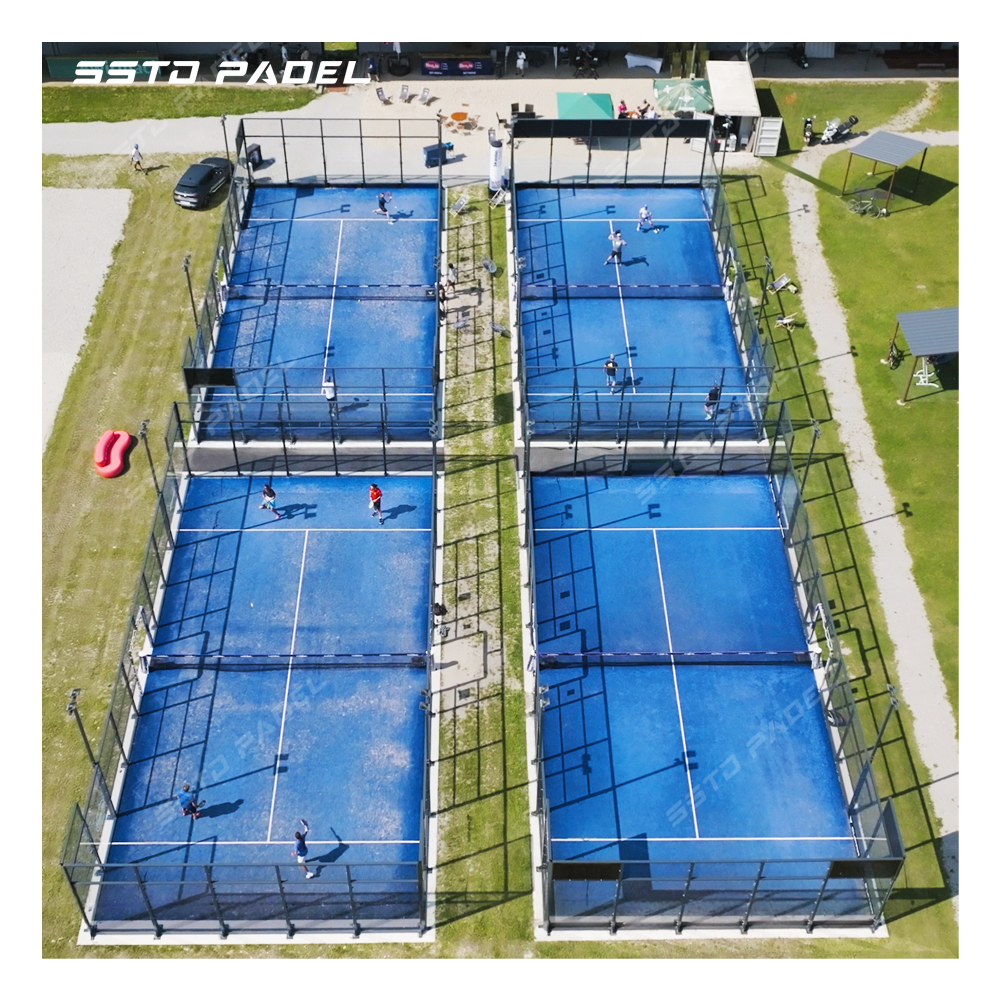
What Are the Latest Trends in Panoramic Padel Court Design?
1. 360-Degree Frameless Glass Structures
One of the most noticeable trends is the development of 360-degree panoramic glass systems.
Traditional court structures often use visible vertical posts between glass panels. Newer designs minimize these interruptions, creating a more open visual environment for spectators, players, and broadcast cameras.
The engineering challenge is transferring structural loads safely without relying on conventional visible posts. Reinforced top and bottom rails, specialized steel connections, and properly designed foundations become particularly important.
For example, some modern 360-degree panoramic court configurations use 12 mm tempered glass panels measuring 2,000 × 3,000 mm. This is a product-specific configuration rather than a universal requirement for every padel court.
When selecting a frameless panoramic padel court structure, buyers should evaluate:
-
Glass thickness and compliance with applicable safety standards.
-
Glass panel dimensions and fixing methods.
-
Structural load calculations and connection design.
-
Foundation requirements and installation accuracy.
-
Impact resistance and long-term maintenance requirements.
The objective is not simply to remove visible posts, but to achieve unobstructed visibility without compromising structural safety.
2. Special-Shaped Steel Tubes and Curved Structural Designs
Another emerging direction is the use of specially shaped steel profiles instead of conventional square or rectangular support tubes.
Fan-shaped arc posts, curved steel sections, and customized structural geometries give panoramic courts a more distinctive architectural appearance. These designs can also help manufacturers develop support configurations that accommodate larger glass panels and different visual requirements.
For outdoor facilities, structural material selection remains essential.
Hot-dip galvanized steel is commonly selected because its zinc coating helps protect the underlying steel against corrosion. This is particularly relevant for coastal sports facilities, humid environments, and outdoor clubs exposed to frequent rainfall.
For example, Shengshi Sports Tech Tianjin Co., Ltd. offers panoramic court configurations using special-profile steel tubes and fan-shaped arc posts.
When comparing these designs, project buyers should pay attention to steel section dimensions, wall thickness, galvanizing specifications, connection details, and local wind-load requirements rather than evaluating appearance alone.
3. Custom Logo Integration and Brand-Oriented Court Design
Padel courts are increasingly becoming part of a sports club's visual identity rather than simply functional playing spaces.
Modern panoramic designs allow customization across several structural and decorative elements:
-
Laser-cut logos integrated into reinforced steel plates.
-
Club and sponsor logos printed on glass panels.
-
Custom-colored artificial turf.
-
Powder-coated steel frames in selected colors.
-
Customized mesh panels and structural finishes.
Logo integration is particularly relevant for commercial clubs, tournament organizers, and sports brands.
For example, laser-cut logo plates provide a permanent branding option compared with conventional adhesive stickers. When combined with 360-degree glass visibility, branding elements can remain visible in spectator photographs, promotional videos, and live-streamed matches.
However, customization should not interfere with player visibility, glass safety, or the uniform appearance of the playing enclosure.
The best approach is to integrate branding during the structural design and manufacturing stages rather than adding decorative elements after installation.
4. Indoor and Covered Panoramic Padel Courts
Weather protection is becoming an important consideration for sports facility developers.
Outdoor courts can be affected by rainfall, excessive sunlight, wind, and seasonal temperature changes. Indoor and covered panoramic courts help facilities maintain more consistent playing conditions and extend their operating opportunities.
Current design options include:
-
Indoor panoramic courts installed in sports halls.
-
Open-sided steel canopy structures.
-
Modular multi-court roofing systems.
-
Large-span tensile membrane structures.
-
Semi-enclosed and fully enclosed sports facilities.
The Lawn Tennis Association's 2025 Padel Court Construction Guidance provides useful benchmarks for covered court design. For structures spanning from one end of the court to the other, it recommends a minimum clear height of 6 meters at the ends and 8 meters above the net line. For side-to-side modular structures, the guidance specifies at least 6 meters at the sides and 8 meters at the highest point above the net.
These dimensions matter because padel involves frequent overhead shots and high lobs.
Material selection is also evolving. Steel-frame structures combined with PVDF tensile membranes provide an alternative to conventional enclosed sports buildings.
For example, a manufacturer's membrane canopy specification may include a 1,100 g/m² PVDF membrane, a B1 fire-retardant rating, and a galvanized steel supporting structure. Actual wind and snow-load requirements must still be verified against the project location and applicable building regulations.
5. Energy-Efficient LED Lighting and Glare Control
Lighting is no longer treated as an additional accessory. It is an important part of panoramic padel court engineering.
Poor lighting distribution can create shadows, glare, and visibility problems, especially when players follow high-speed balls against transparent glass backgrounds.
Modern lighting designs increasingly focus on:
-
Energy-efficient LED floodlights.
-
Uniform illumination across the playing surface.
-
Reduced glare for players and spectators.
-
Weather-resistant IP-rated lighting fixtures.
-
Lighting positions integrated into the court or canopy structure.
According to FIP's court lighting requirements, artificial lighting should be distributed uniformly without creating visual difficulties for players, officials, or spectators. Its rules also specify a minimum vertical illumination level of 1,000 lux for television broadcasts.
This is an important distinction for commercial buyers: the wattage of a floodlight does not directly establish the actual illumination level across the court.
For example, a court configuration with eight 200 W LED floodlights may specify 300 lux, while professional television broadcasting has a separate vertical illumination requirement.
Therefore, buyers should request a lighting layout, measured lux values, and glare-control assessment rather than comparing lighting systems only by the number or power of fixtures.
6. Performance-Based Artificial Turf and Sustainable Materials
Court surface technology is another important area of development.
Artificial turf must do more than provide an attractive playing surface. It directly influences ball behavior, player movement, traction, and injury-related performance considerations.
The SAPCA Code of Practice for the Construction of Padel Courts references the following performance requirements under UNE 147301:
| Performance Property | Reference Requirement |
|---|---|
| Shock Absorbency (Force Reduction) | 15–25% |
| Rotational Resistance | 25–50 Nm |
| Ball Rebound | At least 80% |
| Water Permeability | At least 500 mm/hr |
These measurements provide more useful purchasing criteria than general descriptions such as soft, comfortable, or high-performance turf.
Material durability is also receiving greater attention. Galvanized steel, corrosion-resistant hardware, durable glass connections, and weather-resistant roofing materials can help reduce maintenance requirements over the service life of a facility.
For developers planning outdoor courts, the complete material specification should consider local humidity, rainfall, UV exposure, wind conditions, and maintenance accessibility.
7. Modular Construction and Project-Specific Customization
A further trend is the shift toward modular court manufacturing.
Rather than treating every installation as a completely independent construction project, manufacturers increasingly develop standardized structural components that can be configured for different site layouts.
This approach can support:
-
Single-court and multi-court facilities.
-
Different panoramic structural configurations.
-
Customized court colors and branding.
-
Indoor and outdoor installation requirements.
-
Project-specific canopy integration.
Factory prefabrication and bolt-connected structures can also simplify transportation and on-site assembly.
For sports facility developers, modularity is particularly valuable when planning multiple courts, expanding an existing club, or working with restricted installation areas.
However, modular components must still be matched to the site's foundation design, structural loads, drainage conditions, and local construction requirements.
Where Are Panoramic Padel Courts Commonly Used?
The combination of open glass visibility and customizable structural design makes panoramic courts suitable for several commercial and recreational environments.
1. Professional Padel Clubs and Sports Centers
Premium clubs use panoramic courts to create a more open playing environment and improve spectator visibility. They are suitable for facilities that organize regular matches, coaching programs, and competitive events.
2. Tournament and Competition Venues
Full panoramic designs are particularly relevant for tournament courts, where unobstructed camera angles and spectator viewing positions are important. Custom logos and integrated lighting can also support event branding.
3. Hotels and Luxury Resorts
Hotels and resorts can use panoramic courts as part of their sports and leisure facilities. Customized colors and architectural designs help align the courts with the property's overall visual identity.
4. Commercial Real Estate and Mixed-Use Developments
Residential communities, commercial complexes, and recreational developments can incorporate panoramic padel courts as shared sports amenities to attract residents and visitors.
5. Indoor Sports Facilities and Multi-Court Clubs
Indoor panoramic courts and covered court systems are suitable for locations where rainfall, intense sunlight, or seasonal weather conditions limit outdoor play.
What Are the Main Advantages of Modern Panoramic Padel Court Design?
The latest design developments provide several practical benefits for sports facility operators:
-
Improved Visibility: Reduced structural obstructions provide clearer viewing angles for spectators and cameras.
-
Stronger Brand Recognition: Customized logos, turf colors, and steel finishes help establish a recognizable club identity.
-
Flexible Installation: Indoor, outdoor, and covered configurations accommodate different site conditions.
-
Better Operational Planning: Modular structures can simplify multi-court development and future expansion.
-
Performance and Safety Considerations: Properly specified glass, structural connections, lighting, and turf help maintain consistent playing conditions.
-
Long-Term Material Protection: Galvanized steel and weather-resistant components help address corrosion and environmental exposure.
The most suitable design depends on the project's budget, target customers, climate, available space, and expected operating conditions. A premium 360-degree panoramic court may be appropriate for a flagship venue, while a conventional panoramic structure may offer a more practical balance between visual appeal and investment costs.
How to Choose the Right Panoramic Padel Court for Your Project
Before purchasing, sports club owners, distributors, and project developers should evaluate several technical and commercial factors.
| Selection Factor | What Buyers Should Check |
|---|---|
| Court Dimensions | Standard 20 × 10 m playing area |
| Glass System | Tempered glass specifications, safety standards, and fixing structure |
| Steel Framework | Steel grade, tube dimensions, galvanizing, and structural calculations |
| Turf System | Ball rebound, shock absorption, rotational resistance, and drainage |
| Lighting | Actual lux measurements, uniformity, glare, and IP rating |
| Roofing | Clear height, wind resistance, drainage, and local weather conditions |
| Customization | Logo integration, turf color, frame color, and mesh design |
| Installation | Foundation drawings, assembly instructions, and technical support |
A reliable manufacturer should be able to provide detailed product specifications, structural drawings, material information, and installation guidance before the project moves into production.
Conclusion: Choosing the Right Panoramic Padel Court Design for the Future
The latest trends in panoramic padel court design show a clear movement toward 360-degree glass visibility, customized steel structures, integrated branding, covered installations, energy-efficient lighting, and performance-based surface materials.
For commercial buyers, choosing a court should involve more than comparing appearance and purchase price. Structural safety, material specifications, playing performance, installation conditions, and long-term maintenance all influence the overall value of the investment.
Shengshi Sports Tech Tianjin Co., Ltd. (SSTD), established in 1998, specializes in sports equipment manufacturing, including panoramic padel courts, custom court structures, and sports facility solutions. With a reported 24,000-square-meter manufacturing facility and exports to 80 countries, the company provides different court configurations for sports clubs, distributors, and commercial projects.
For developers planning a custom panoramic padel court for sports clubs, the next step is to define the venue dimensions, installation environment, preferred glass structure, branding requirements, and expected operating conditions. These details provide a practical foundation for selecting a suitable court configuration and obtaining an accurate project quotation.
Frequently Asked Questions About Panoramic Padel Court Design
1. What Is the Difference Between a Panoramic and a 360-Degree Panoramic Padel Court?
A standard panoramic padel court generally uses larger glass panels and reduces some visible structural obstructions. A 360-degree super panoramic court goes further by minimizing or eliminating corner and vertical posts along the glass walls. The actual configuration depends on the manufacturer's structural design.
2. What Glass Thickness Is Recommended for a Panoramic Padel Court?
A 12 mm tempered glass configuration is commonly used in commercial panoramic padel court products. However, glass thickness alone does not determine safety. Buyers should also check compliance with applicable glass standards, panel dimensions, impact performance, fixing methods, and structural calculations.
3. What Is the Standard Size of a Panoramic Padel Court?
The standard playing area is 20 meters long and 10 meters wide, measured from the inside of the enclosure. The surrounding structure, foundations, lighting positions, and safety clearances require additional installation space.
4. Can a Panoramic Padel Court Be Installed Outdoors?
Yes. Panoramic courts can be installed outdoors when the steel framework, glass connections, foundations, lighting, and other components are appropriately specified for local environmental conditions. Hot-dip galvanized steel and IP-rated lighting are common options for outdoor installations.
5. Can Panoramic Padel Courts Be Customized With Company Logos?
Yes. Customization options may include laser-cut steel logo plates, printed glass logos, colored artificial turf, and powder-coated structural frames. These options are particularly suitable for branded sports clubs, tournament venues, and sponsor-supported facilities.
6. Are Covered Panoramic Padel Courts Suitable for Year-Round Operation?
Covered panoramic courts can reduce disruption caused by rainfall and direct sunlight. However, the roofing structure must provide sufficient clear height, appropriate ventilation, drainage, and structural resistance to local wind and snow loads. Actual year-round usability depends on the local climate and facility design.
7. What Should Buyers Consider When Choosing a Panoramic Padel Court Manufacturer?
Buyers should evaluate manufacturing experience, glass safety standards, steel material specifications, structural engineering capabilities, customization options, quality inspection procedures, export experience, and installation support. Requesting technical drawings and detailed quotations before placing an order helps reduce project risks.

Table of Contents
- Introduction: Why Panoramic Padel Court Design Is Gaining Popularity
- What Is a Panoramic Padel Court?
-
What Are the Latest Trends in Panoramic Padel Court Design?
- 1. 360-Degree Frameless Glass Structures
- 2. Special-Shaped Steel Tubes and Curved Structural Designs
- 3. Custom Logo Integration and Brand-Oriented Court Design
- 4. Indoor and Covered Panoramic Padel Courts
- 5. Energy-Efficient LED Lighting and Glare Control
- 6. Performance-Based Artificial Turf and Sustainable Materials
- 7. Modular Construction and Project-Specific Customization
- Where Are Panoramic Padel Courts Commonly Used?
- What Are the Main Advantages of Modern Panoramic Padel Court Design?
- How to Choose the Right Panoramic Padel Court for Your Project
- Conclusion: Choosing the Right Panoramic Padel Court Design for the Future
-
Frequently Asked Questions About Panoramic Padel Court Design
- 1. What Is the Difference Between a Panoramic and a 360-Degree Panoramic Padel Court?
- 2. What Glass Thickness Is Recommended for a Panoramic Padel Court?
- 3. What Is the Standard Size of a Panoramic Padel Court?
- 4. Can a Panoramic Padel Court Be Installed Outdoors?
- 5. Can Panoramic Padel Courts Be Customized With Company Logos?
- 6. Are Covered Panoramic Padel Courts Suitable for Year-Round Operation?
- 7. What Should Buyers Consider When Choosing a Panoramic Padel Court Manufacturer?